
Lead in School Drinking Water EPA 3Ts: What Parents Can Ask For in 2026
On October 29, 2026, EPA Administrator Lee Zeldin announced $26 million in funding for states and territories to address lead in drinking water at schools and child care facilities. One word matters more than the dollar figure, and that word is voluntary. EPA built its 3Ts toolkit (Training, Testing, and Taking Action) to help facilities run a voluntary program for reducing lead in drinking water. It also gives you a step-by-step way to ask your child’s school for its results.
Is lead testing in schools required by federal law?
For most schools and child care centers, it is not. EPA’s 3Ts fact sheet states that there are no federal laws requiring testing of drinking water in schools and child care facilities. The exception is a facility that owns or operates its own public water supply, because that facility is regulated under the Safe Drinking Water Act. In most buildings, then, EPA’s guidance on lead testing in schools is a recommendation, not a rule.
EPA’s 3Ts page describes its materials as information and recommendations to prepare schools, child care facilities, and states to build a voluntary implementation program. EPA’s main lead page describes the 3Ts program as providing information and recommendations to prepare schools, childcare facilities, and states to build a voluntary implementation program. States can add their own rules. That is why the toolkit tells facilities to contact state programs to determine whether any other requirements apply.
In practice, responsibility falls on the school or child care operator, plus your state if it has passed its own rules. Federal grant money goes to states and territories through the Reducing Lead Where Children Learn Grant Program.
The stakes are high. EPA and CDC agree that there is no known safe level of lead in a child’s blood, and EPA’s non-enforceable health goal for lead in drinking water is zero.
What each of the three Ts asks a facility to do
Training. The toolkit gives facilities templates to get a team together, create a contact list, identify a target area, and plan how and when to communicate.
Testing. The toolkit says the state drinking water office should be able to provide a list of certified laboratories. EPA also offers a 7-minute 3Ts Lead Sampling Video from August 2022. Child care centers have their own resources, including the Know Your Plumbing! factsheet.
Taking action. EPA encourages schools to prioritize remediation efforts based on lead sample results and to bring lead to the lowest possible levels. The toolkit’s list of immediate steps includes:
- Removing drinking water coolers with lead-lined tanks built before the 1986 Lead Free Act.
- Cleaning fountains and aerators (the small screens on faucets) on a regular schedule.
- Using only cold water for food and drinks.
- Flushing drinking outlets after weekends and long vacations (epa.gov).
Taking action also covers communicating to parents, staff, and the larger school community and keeping records. The 3Ts includes recordkeeping templates for this.
Step by step: getting answers from your child’s school
Find the person in charge. Ask the front office who runs the building’s drinking water program. In a district, that is often the facilities office.
Ask whether the building has been tested, when, and by which lab. If the school can’t name a lab, ask whether the state drinking water office provided a list of certified laboratories.
Ask for results for each outlet. A building-wide average can hide one bad fountain. Ask which outlets were sampled and what was done about each high reading.
Ask when flushing happens compared with sampling. This is the most common problem. The toolkit says routine practices such as flushing should not be conducted immediately prior to collecting a water sample. A sample taken right after flushing can understate what children drink on a Monday morning.
Ask about state rules and grant money. Ask whether your state requires testing, and whether the school’s testing was paid for by the grant program. EPA sets an allotment for each of the 50 states, the District of Columbia, and four territories.
Read your water supplier’s report. The water entering the building comes from a utility. That utility’s Consumer Confidence Report is a useful starting point.
You can adapt this request:
Subject: Request for drinking water lead testing records

Hello,

I am the parent of a student at [school name]. Could you share:
1. The date(s) drinking water was last tested for lead, and the lab used
2. Results for each sampled outlet
3. Actions taken where results were elevated
4. The current flushing and aerator-cleaning schedule
5. Whether our state requires testing, and whether the school
   participates in EPA's 3Ts program or a state grant program

Thank you,
[Your name]
Key dates for lead in school and child care water
| Date | Event | Impact |
|---|---|---|
| 1974 | Safe Drinking Water Act passed | Covers facilities with their own water supply |
| 1986 | Lead Free Act | Coolers built before it may be lead-lined |
| 2018 | Revised 3Ts toolkit released | Current voluntary framework |
| Oct 2018 | 3Ts manual and tribal schools guide | Core guidance documents |
| 2025 | EPA lead committee reestablished | Agency-wide focus on child lead exposure |
Far more buildings have been tested than fixed
EPA’s figures show a gap between testing and repairs. EPA says the grant program has provided over $300 million since 2018. This investment has helped nearly 33,000 child care facilities and more than 18,000 schools test their water for lead while advancing work to address lead pipes or fixtures at over 2,400 child care facilities and 4,200 schools (epa.gov).
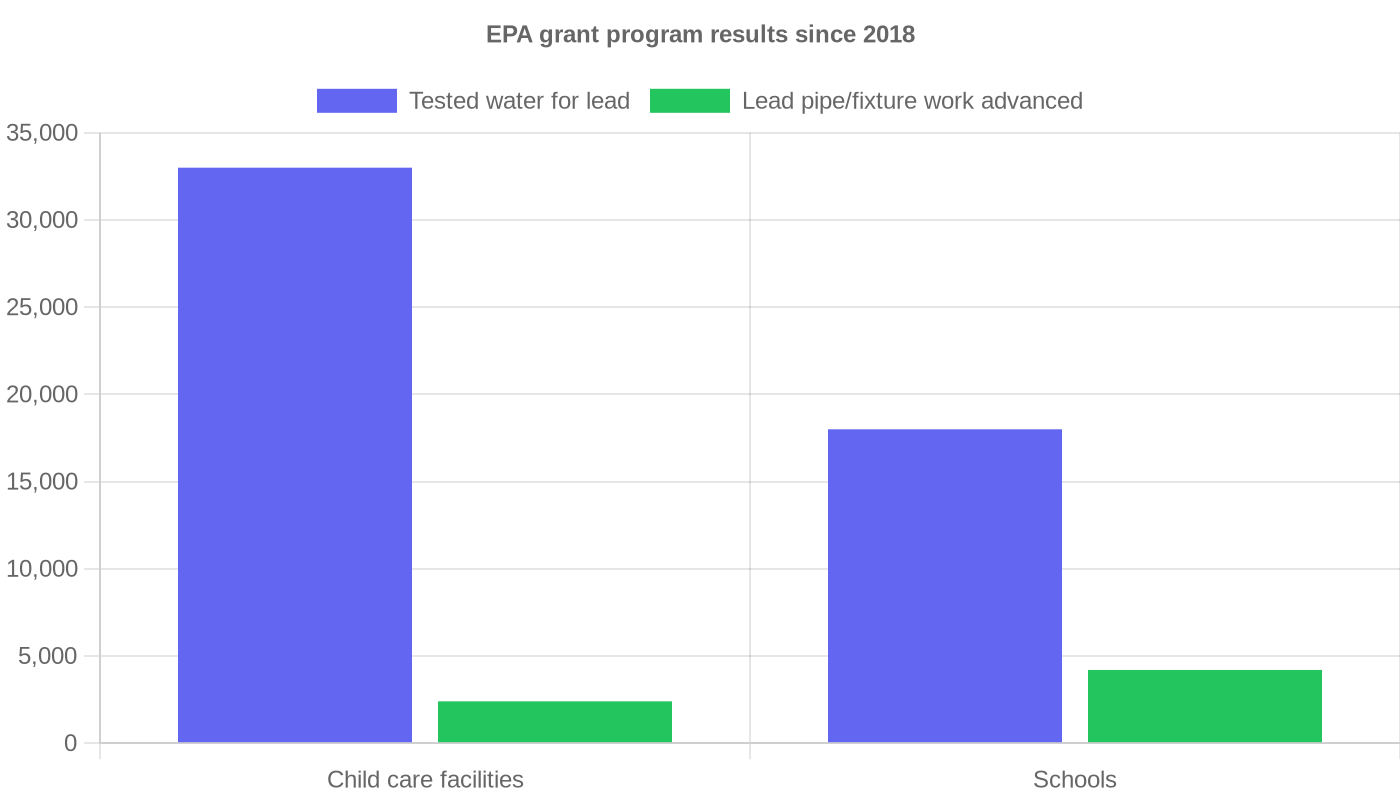
Testing is only the first step. Because these programs are voluntary, parents who ask questions are often the ones who get both the results and the repairs.
Sources
- epa.gov – “3Ts Toolkit - EPA”
- epa.gov – “3Ts for Reducing Lead in Drinking Water” (2021)
- epa.gov – “EPA Announces $26 Million to Reduce Exposure to Toxic …” (2026)
- epa.gov – “Lead in Drinking Water | US EPA” (2026)
- epa.gov – “WIIN Grant: Voluntary School and Child Care Lead Testing and Reduction Grant Program | US EPA” (2021)